

How Much Money Can I Get For An 1893 Copy Of The Scarlet Letter
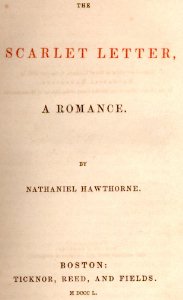 Title folio, first edition, 1850 | |
| Author | Nathaniel Hawthorne |
|---|---|
| Country | Us |
| Language | English |
| Genre | Romantic, Historical| Thriller|Supernatural |
| Publisher | Ticknor, Reed & Fields |
| Publication appointment | 1850 |
| Dewey Decimal | 813.iii |
| Text | The Scarlet Alphabetic character at Wikisource |
The Cherry-red Letter: A Romance is a piece of work of historical fiction past American author Nathaniel Hawthorne, published in 1850.[one] Ready in Puritan Massachusetts Bay Colony during the years 1642 to 1649, the novel tells the story of Hester Prynne, who conceives a girl through an matter and and so struggles to create a new life of repentance and dignity. Containing a number of religious and historic allusions, the volume explores themes of legalism, sin, and guilt.
The Scarlet Letter was one of the first mass-produced books in the Usa. It was pop when first published[2] and is considered a archetype piece of work today.[3] Information technology inspired numerous picture, television receiver, and phase adaptations. Critics have described it as a masterwork,[four] and novelist D. H. Lawrence called information technology a "perfect piece of work of the American imagination".[5]
Plot [edit]
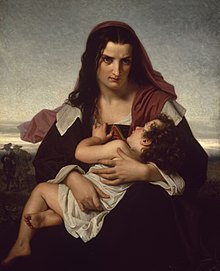
In this painting, The Scarlet Letter of the alphabet past Hugues Merle (1861), Hester Prynne and Pearl are in the foreground and Arthur Dimmesdale and Roger Chillingworth are in the background.
In Puritan Boston, Massachusetts, a oversupply gathers to witness the punishment of Hester Prynne, a young woman who has given birth to a baby of unknown parentage. Her sentence required her to stand on the scaffold for three hours, exposed to public humiliation, and to wear the crimson "A" for the rest of her life. Equally Hester approaches the scaffold, many of the women in the crowd are angered past her beauty and repose dignity. When commanded and cajoled to name the father of her kid, Hester refuses.
As Hester looks out over the crowd, she notices a small, misshapen man and recognizes him as her long-lost hubby, who has been presumed lost at sea. When the husband sees Hester's shame, he asks a man in the oversupply about her and is told the story of his wife'southward infidelity. He angrily exclaims that the child's male parent, the partner in the adulterous act, should also exist punished and vows to detect the human. He chooses a new proper noun, Roger Chillingworth, to assistance him in his plan.
The Reverend John Wilson and the minister of Hester's church, Arthur Dimmesdale, question her, merely she refuses to name her lover. After she returns to her prison cell, the jailer brings in Chillingworth, now a medico, to at-home Hester and her kid with his roots and herbs. He and Hester have an open conversation regarding their wedlock and the fact that they were both in the wrong. Her lover, however, is another matter and he demands to know who it is; Hester refuses to divulge such information. He accepts this, stating that he will notice out anyway, and forces her to conceal that he is her husband. If she ever reveals him, he warns her, he will destroy the child'south father. Hester agrees to Chillingworth's terms although she suspects she will regret it.
Following her release from prison, Hester settles in a cottage at the edge of town and earns a meager living with her needlework, which is of boggling quality. She lives a tranquillity, somber life with her daughter, Pearl, and performs acts of charity for the poor. She is troubled by her daughter's unusual fascination with the cherry "A". The shunning of Hester also extends to Pearl, who has no playmates or friends except her mother. As she grows older, Pearl becomes capricious and unruly. Her acquit starts rumors, and, non surprisingly, the church members propose Pearl be taken abroad from Hester.
Hester, hearing rumors that she may lose Pearl, goes to speak to Governor Bellingham. With him are ministers Wilson and Dimmesdale. Hester appeals to Dimmesdale in desperation, and the minister persuades the governor to let Pearl remain in Hester's intendance.
Because Dimmesdale'south health has begun to fail, the townspeople are happy to have Chillingworth, the newly arrived physician, take up lodgings with their beloved minister. Existence in such shut contact with Dimmesdale, Chillingworth begins to doubtable that the minister'due south illness is the result of some unconfessed guilt. He applies psychological force per unit area to the minister considering he suspects Dimmesdale is Pearl's begetter. One evening, pulling the sleeping Dimmesdale's vestment aside, Chillingworth sees a symbol that represents his shame on the minister's stake chest.
Tormented past his guilty censor, Dimmesdale goes to the foursquare where Hester was punished years earlier. Climbing the scaffold in the dead of night, he admits his guilt but cannot notice the courage to practise so publicly in the light of day. Hester, shocked by Dimmesdale's deterioration, decides to obtain a release from her vow of silence to her husband.
Several days later, Hester meets Dimmesdale in the woods and tells him of her husband and his desire for revenge. She convinces Dimmesdale to leave Boston in secret on a ship to Europe where they can kickoff life anew. Inspired past this plan, the minister seems to gain new free energy. On Ballot Solar day, Dimmesdale gives one of his most inspired sermons. But equally the procession leaves the church, Dimmesdale climbs upon the scaffold and confesses his sin, dying in Hester's arms. Later, nearly witnesses swear that they saw a stigma in the form of a carmine "A" upon his breast, although some deny this statement. Chillingworth, losing his will for revenge, dies before long thereafter and leaves Pearl a substantial inheritance.
Afterwards several years, Hester returns to her cottage and resumes wearing the scarlet letter. When she dies, she is buried near the grave of Dimmesdale, and they share a simple slate tombstone engraved with an escutcheon described as: "On a field, sable, the letter A, gules" ("A reddish letter A written on a black groundwork").
Major theme [edit]
The major theme of The Cherry-red Letter is shaming and social stigmatizing, both Hester's public humiliation and Dimmesdale's private shame and fear of exposure. Notably, their liaison is never spoken of, and so the circumstances that led to Hester's pregnancy, and how their affair was kept cloak-and-dagger never become role of the plot.
Elmer Kennedy-Andrews remarks that Hawthorne in "The Custom-house" sets the context for his story and "tells the states about 'romance', which is his preferred generic term to describe The Scarlet Letter, as his subtitle for the book – 'A Romance' – would betoken." In this introduction, Hawthorne describes a infinite between materialism and "dreaminess" that he calls "a neutral territory, somewhere betwixt the real globe and fairy-state, where the Bodily and the Imaginary may meet, and each imbues itself with nature of the other". This combination of "dreaminess" and realism gave the author space to explore major themes.[6]
Other themes [edit]
The experience of Hester and Dimmesdale recalls the story of Adam and Eve because, in both cases, sin results in expulsion and suffering. But it as well results in knowledge – specifically, in noesis of what it means to be immoral. For Hester, the Scarlet Letter is a concrete manifestation of her sin and reminder of her painful confinement. She contemplates casting it off to obtain her freedom from an oppressive society and a checky past also as the absence of God. Because the order excludes her, she considers the possibility that many of the traditions upheld by the Puritan culture are untrue and are not designed to bring her happiness.
As for Dimmesdale, the "cheating government minister", his sin gives him "sympathies and so intimate with the sinful brotherhood of mankind, then that his breast vibrate[s] in unison with theirs." His eloquent and powerful sermons derive from this sense of empathy.[7] The narrative of the Reverend Arthur Dimmesdale is quite in keeping with the oldest and nearly fully authorized principles in Christian thought.[ citation needed ] His "Fall" is a descent from apparent grace to his ain damnation; he appears to begin in purity simply he ends in corruption. The subtlety is that the government minister'southward conventionalities is his ain adulterous, convincing himself at every stage of his spiritual pilgrimage that he is saved.[8]
The rose bush'south dazzler forms a striking contrast to all that surrounds it; as later the beautifully embroidered scarlet "A" will be held out in part as an invitation to detect "some sweet moral flower" in the ensuing, tragic tale and in part equally an prototype that "the deep middle of nature" (perhaps God) may look more kindly on the errant Hester and her kid than her Puritan neighbors exercise. Throughout the work, the nature images contrast with the stark darkness of the Puritans and their systems.[9]
Chillingworth's misshapen trunk reflects (or symbolizes) the anger in his soul, which builds as the novel progresses, similar to the manner Dimmesdale's illness reveals his inner turmoil. The outward man reflects the status of the heart; an observation thought inspired by the deterioration of Edgar Allan Poe, whom Hawthorne "much admired".[9]
Another theme is the extreme legalism of the Puritans and how Hester chooses non to conform to their rules and beliefs. Hester was rejected by the villagers even though she spent her life doing what she could to help the sick and the poor. Considering of the social shunning, she spent her life generally in confinement and would not get to church building.
As a result, she retreats into her own mind and her ain thinking. Her thoughts brainstorm to stretch and go beyond what would be considered past the Puritans as safety. She nevertheless sees her sin, only begins to await on it differently than the villagers ever have. She begins to believe that a person's earthly sins practice not necessarily condemn them. She even goes and then far equally to tell Dimmesdale that their sin has been paid for by their daily penance and that their sin volition not go along them from getting to heaven, although the Puritans believed that such a sin surely condemns.[ dubious ] [ citation needed ]
But Hester had been alienated from the Puritan society, both in her physical life and spiritual life. When Dimmesdale dies, she knows she has to movement on considering she tin can no longer suit to the Puritans' strictness. Her thinking is free from Puritan religious premises and she has established her own dissimilar moral standards and beliefs.[7]
Publication history [edit]

Hester Prynne at the pillory, an engraved illustration from an 1878 edition
Information technology was long thought that Hawthorne originally planned The Scarlet Letter to exist a shorter novelette, part of a collection named Quondam Time Legends, and that his publisher, James T. Fields, convinced him to expand the work to a full-length novel.[10] This is non true: Fields persuaded Hawthorne to publish The Scarlet Letter alone (along with the before-completed "Custom Business firm" essay) simply he had zero to do with the length of the story.[eleven] Hawthorne's wife Sophia afterwards challenged Fields' claims a little inexactly: "he has made the cool boast that he was the sole cause of the Red Alphabetic character being published!" She noted that her hubby's friend Edwin Percy Whipple, a critic, approached Fields to consider its publication.[12] The manuscript was written at the Peter Edgerley Firm in Salem, Massachusetts, still standing every bit a individual residence at 14 Mall Street. It was the final Salem home where the Hawthorne family lived.[13]
The Scarlet Letter was first published in the leap of 1850 past Ticknor and Fields, beginning Hawthorne'southward most lucrative period.[two] When he delivered the final pages to Fields in February 1850, Hawthorne said that "some portions of the volume are powerfully written" merely doubted information technology would be popular.[14] In fact, the book was an instant all-time-seller, though, over fourteen years, it brought its writer only $i,500.[2] Its initial publication brought wide protest from natives of Salem, who did not approve of how Hawthorne had depicted them in his introduction "The Custom-House". A 2,500-copy 2nd edition included a preface by Hawthorne dated March 30, 1850, that stated he had decided to reprint his Introduction "without the change of a word... The simply remarkable features of the sketch are its frank and 18-carat good-humor ... As to enmity, or ill-feeling of any kind, personal or political, he utterly disclaims such motives".[15]
The Blood-red Letter was also one of the start mass-produced books in America. In the mid-nineteenth century, bookbinders of home-grown literature typically manus-made their books and sold them in minor quantities. The start mechanized printing of The Scarlet Letter, 2,500 volumes, sold out within ten days,[2] and was widely read and discussed to an extent non much experienced in the immature country up until that time. Copies of the outset edition are oftentimes sought by collectors equally rare books, and may fetch upwardly to around $18,000 USD.
Critical response [edit]
On its publication, critic Evert Augustus Duyckinck, a friend of Hawthorne's, said he preferred the author's Washington Irving-like tales. Another friend, critic Edwin Percy Whipple, objected to the novel's "morbid intensity" with dense psychological details, writing that the book "is therefore apt to become, like Hawthorne, besides painfully anatomical in his exhibition of them".[16] English author Mary Anne Evans writing equally "George Eliot", chosen The Scarlet Letter, along with Henry Wadsworth Longfellow's 1855 book-length poem The Song of Hiawatha, the "two most indigenous and masterly productions in American literature".[17] Most literary critics praised the book but religious leaders took issue with the novel'south bailiwick matter.[xviii] Orestes Brownson complained that Hawthorne did not understand Christianity, confession, and remorse.[19] A review in The Church Review and Ecclesiastical Register concluded the author "perpetrates bad morals."[20]
On the other hand, 20th-century writer D. H. Lawrence said that in that location could not be a more perfect work of the American imagination than The Scarlet Letter.[5] Henry James one time said of the novel, "It is beautiful, admirable, extraordinary; it has in the highest caste that merit which I have spoken of as the mark of Hawthorne'southward best things—an indefinable purity and lightness of conception...1 can frequently return to it; information technology supports familiarity and has the inexhaustible charm and mystery of bully works of art."[5] [21]
Allusions [edit]
The post-obit are historical and Biblical references that appear in The Cherry Letter.
- Anne Hutchinson, mentioned in Chapter 1, "The Prison house Door", was a religious dissenter (1591–1643). In the 1630s she was excommunicated by the Puritans and exiled from Boston, and moved to Rhode Island.[ix]
- Ann Hibbins, who historically was executed for witchcraft in Boston in 1656, is depicted in The Carmine Alphabetic character as a witch who tries to tempt Prynne to the practice of witchcraft.[22] [23]
- Richard Bellingham (c. 1592–1672), who historically was the governor of Massachusetts and deputy governor at the time of Hibbins's execution, was depicted in The Scarlet Letter equally the brother of Ann Hibbins.
- Martin Luther (1483–1545) was a leader of the Protestant Reformation in Germany.
- Increase Mather (1639–1723), a powerful leader of the early Massachusetts Bay Colony. He was a Puritan government minister involved with the government of the colony, and also the Salem Witch Trials.
- Sir Thomas Overbury and Dr. Forman were the subjects of an adultery scandal in 1615 in England. Dr. Forman was charged with trying to toxicant his cheating wife and her lover. Overbury was a friend of the lover and was peradventure poisoned.
- John Winthrop (1588–1649), second governor of the Massachusetts Bay Colony.
- Rex'south Chapel Burying Ground, mentioned in the concluding paragraph, exists; the Elizabeth Pain gravestone is traditionally considered an inspiration for the protagonists' grave.
- The story of King David and Bathsheba is depicted in the tapestry in Mr. Dimmesdale'south room (chapter 9). (See II Samuel xi–12 for the Biblical story.)
- John Eliot (c. 1604–1690) was a Puritan missionary to the American Indians whom some called "the apostle to the Indians". He is referred to every bit "the Apostle Eliot" whom Dimmesdale has gone to visit at the beginning of Affiliate 16, "A Forest Walk".
Symbols [edit]
The following are symbols that are embedded in The Scarlet Letter:
- The Ruby-red Letter A: In the beginning of the novel Hester's letter A is a representation of her sin and adultery. However, as time progresses, the pregnant of the alphabetic character changed. It now represented, to some, able. Information technology states "The letter was the symbol of her calling. Such helpfulness was institute in her—then much power to exercise, and power to empathise—that many people refused to translate the scarlet A past its original signification. They said that it meant Able, so strong was Hester Prynne, with a adult female's forcefulness" (129).[24]
- Meteor: The meteor shaped as an A serves as another symbol in the book. To Reverend Dimmesdale the meteor is a sign from God who is revealing his sin to everyone and causes him to be ridden with guilt. Nonetheless, others perceived the letter to be a symbol for affections.[24]
- Dimmesdale's name: Dimmesdale's name itself also holds symbolism. His name contains the root give-and-take "dim" which evokes the feeling of faint, weak, and gloom. This represents the constant land Dimmesdale finds himself in. His life has dimmed itself ever since his sin, causing his light of life to fade and dim.[24]
- Pearl: Pearl symbolizes the embodiment of her parents' sin and passion. She is a constant reminder of the sin from which her female parent cannot escape. It is mentioned she "was the scarlet letter in another form; the reddish letter of the alphabet endowed in life" (84).[24]
- Rosebush: The rosebush is mentioned twice inside the grade of the story. At the beginning, it is first viewed as nature's way of offering beauty to those who leave and enter the prison too as providing a glimmer of hope to those who inhabit it. The rosebush is perceived as a symbol of brightness in a story filled with human sorrow.[24]
- The Scaffold: The scaffold is mentioned three times throughout the novel. Information technology can be viewed as separating the book into the beginning, centre, and terminate. It symbolizes shame, revelation of sin, and guilt for it is where Hester received her scarlet letter equally punishment and where Dimmesdale experiences his revelation through the meteor.[24]
Adaptations and influence [edit]
The Red Alphabetic character has inspired numerous motion-picture show, goggle box, and stage adaptations, and plot elements have influenced several novels, musical works, and screen productions.
See as well [edit]
- Badge of shame
- Boston in fiction
- Colonial history of the United states
- Illegitimacy in fiction
- Whore of Babylon
- Angel and Apostle, a 2005 novel about the same characters
References [edit]
Notes [edit]
- ^ Hawthorne, Nathaniel (1850). The Scarlet Alphabetic character: A Romance story (2 ed.). Boston: Ticknor, Reed and Fields. Retrieved July 22, 2022 – via Internet Archive.
- ^ a b c d McFarland, Philip. Hawthorne in Concord. New York: Grove Printing, 2004: 136. ISBN 0-8021-1776-7
- ^ "The 100 best novels: No 16 – The Reddish Letter by Nathaniel Hawthorne (1850) | Books | The Guardian". TheGuardian.com. half dozen January 2022.
- ^ "Sinner, Victim, Object, Winner | ANCHORS: JACKI LYDEN". National Public Radio (NPR). March 2, 2008. (quote in article refers to it as his "masterwork", listen to the audio to hear it the original reference to information technology being his "magnum opus")
- ^ a b c Miller, Edwin Haviland. Salem is my Dwelling Place: A Life of Nathaniel Hawthorne. Iowa City: University of Iowa Printing, 1991: 284. ISBN 0-87745-332-2
- ^ Kennedy-Andrews (1999), p. 8–9.
- ^ a b "The Scarlet Alphabetic character". Sparknotes. Retrieved 2012-08-07 .
- ^ Davidson, Due east.H. 1963. Dimmesdale's Fall. The New England Quarterly 36: 358–370
- ^ a b c The Scarlet Letter by Nathaniel Hawthorne, CliffNotes from Yahoo! Instruction
- ^ Charvat, William. Literary Publishing in America: 1790–1850. Amherst, MA: The University of Massachusetts Press, 1993 (first published 1959): 56. ISBN 0-87023-801-ix
- ^ Parker, Hershel. "The Germ Theory of The Cherry Alphabetic character," Hawthorne Social club Newsletter eleven (Bound 1985) 11-xiii.
- ^ Wineapple, Brenda. Hawthorne: A Life. Random House: New York, 2003: 209–210. ISBN 0-8129-7291-0.
- ^ Wright, John Hardy. Hawthorne'southward Haunts in New England. Charleston, SC: The History Press, 2008: 47. ISBN 978-ane-59629-425-seven.
- ^ Miller, Edwin Haviland. Salem is my Dwelling Place: A Life of Nathaniel Hawthorne. Iowa City: University of Iowa Press, 1991: 299. ISBN 0-87745-332-2
- ^ Miller, Edwin Haviland. Salem is my Dwelling Place: A Life of Nathaniel Hawthorne. Iowa City: University of Iowa Press, 1991: 301. ISBN 0-87745-332-2
- ^ Miller, Edwin Haviland. Salem is my Habitation Place: A Life of Nathaniel Hawthorne. Iowa City: University of Iowa Press, 1991: 301–302. ISBN 0-87745-332-2
- ^ Davidson, Mashall B. The American Heritage History of the Writers' America. New York: American Heritage Publishing Company, Inc., 1973: 162. ISBN 0-07-015435-Ten
- ^ Schreiner, Samuel A., Jr. The Concord Quartet: Alcott, Emerson, Hawthorne, Thoreau, and the Friendship That Freed the American Mind. Hoboken, NJ: John Wiley & Sons, Inc., 2006: 158. ISBN 978-0-471-64663-1
- ^ Crowley, J. Donald, and Orestes Brownson. Chapter l: [Orestes Brownson], From A Review In Brownson's Quarterly Review." Nathaniel Hawthorne (0-415-15930-X) (1997): 175–179. Literary Reference Heart Plus. Spider web. 11 October. 2022.
- ^ Wineapple, Brenda. Hawthorne: A Life. Random House: New York, 2003: 217. ISBN 0-8129-7291-0.
- ^ James, Henry (1901). Hawthorne. Harper. pp. 108, 116.
it has in the highest degree that merit.
- ^ Schwab, Gabriele. The Mirror and the Killer-Queen: Otherness in Literary Language. Indiana University Press. 1996. Pg. 120.
- ^ Hunter, Dianne, Seduction and Theory: Readings of Gender, Representation, and Rhetoric. University of Illinois Printing. 1989. Pgs. 186–187
- ^ a b c d eastward f "The Scarlet Letter (Barnes & Noble Classics Serial)". Barnes & Noble. Retrieved 2018-06-04 .
Bibliography [edit]
- Boonyaprasop, Marina. Hawthorne's Wilderness: Nature and Puritanism in Hawthorne's The Ruby-red Letter and "Young Goodman Brown" (Ballast Academic Publishing, 2022).
- Brodhead, Richard H. Hawthorne, Melville, and the Novel. Chicago and London: The University of Chicago Press, 1973.
- Chocolate-brown, Gillian. "'Hawthorne, Inheritance, and Women's Holding", Studies in the Novel 23.1 (Spring 1991): 107–18.
- Cañadas, Ivan. "A New Source for the Title and Some Themes in The Scarlet Letter ". Nathaniel Hawthorne Review 32.i (Leap 2006): 43–51.
- Kennedy-Andrews, Elmer (1999). Nathaniel Hawthorne: The Scarlet Letter . Columbia Critical Guides. New York: Columbia University Press. ISBN9780231121903.
- Korobkin, Laura Haft. "The Scarlet Alphabetic character of the Law: Hawthorne and Criminal Justice". Novel: a Forum on Fiction 30.2 (Winter 1997): 193–217.
- Gartner, Matthew. "The Cherry-red Letter and the Book of Esther: Scriptural Letter of the alphabet and Narrative Life". Studies in American Fiction 23.ii (Autumn 1995): 131–51.
- Newberry, Frederick. "Tradition and Disinheritance in The Scarlet Letter ". ESQ: A journal of the American Renaissance 23 (1977), i–26; repr. in: The Scarlet Letter. W. W. Norton, 1988: pp. 231–48.
- Reid, Alfred South. Sir Thomas Overbury'southward Vision (1616) and Other English language Sources of Nathaniel Hawthorne's 'The Cherry-red Letter. Gainesville, FL: Scholar's Facsimiles and Reprints, 1957.
- Reid, Bethany. "Narrative of the Captivity and Redemption of Roger Prynne: Rereading The Scarlet Letter of the alphabet ". Studies in the Novel 33.3 (Autumn 2001): 247–67.
- Ryskamp, Charles. "The New England Sources of The Scarlet Letter ". American Literature 31 (1959): 257–72; repr. in: The Carmine Letter, 3rd ed. Norton, 1988: 191–204.
- Savoy, Eric. "'Filial Duty': Reading the Patriarchal Trunk in 'The Custom Business firm'". Studies in the Novel 25.4 (Wintertime 1993): 397–427.
- Sohn, Jeonghee. Rereading Hawthorne's Romance: The Problematics of Happy Endings. American Studies Monograph Serial, 26. Seoul: American Studies Plant, Seoul National University, 2001; 2002.
- Stewart, Randall (ed.) The American Notebooks of Nathaniel Hawthorne: Based upon the Original Manuscripts in the Piermont Morgan Library. New Haven: Yale Academy Press, 1932.
- Waggoner, Hyatt H. Hawthorne: A Critical Written report, 3rd ed. Cambridge, MA: Belknap Press of Harvard University Press, 1971.
External links [edit]
- The Ruddy Alphabetic character at Standard Ebooks
- The Scarlet Letter at Project Gutenberg
-
 The Crimson Letter public domain audiobook at LibriVox
 - "Critical Commentary Related to Female Characters in The Reddish Letter "—Hawthorne in Salem Website
- Excerpts from the opera The Scarlet Letter past Fredric Kroll at YouTube
- Seabrook, Andrea (2 March 2008). "Hester Prynne: Sinner, Victim, Object, Winner". In Character: A half dozen-month series exploring the great characters of American fiction, folklore and popular culture. (Opinion). All Things Considered. NPR. Retrieved 12 March 2022.

Source: https://en.wikipedia.org/wiki/The_Scarlet_Letter
Posted by: kirschbaumherradis.blogspot.com
0 Response to "How Much Money Can I Get For An 1893 Copy Of The Scarlet Letter"
Post a Comment